Meet Our Speakers - Jessie MacInnis
Meet Jessie MacInnis - a PhD Candidate (Geography) at the University of Manitoba, and a member of the National Farmers Union Nova Scotia and La Via Campesina
Interview by Leah Jenkins
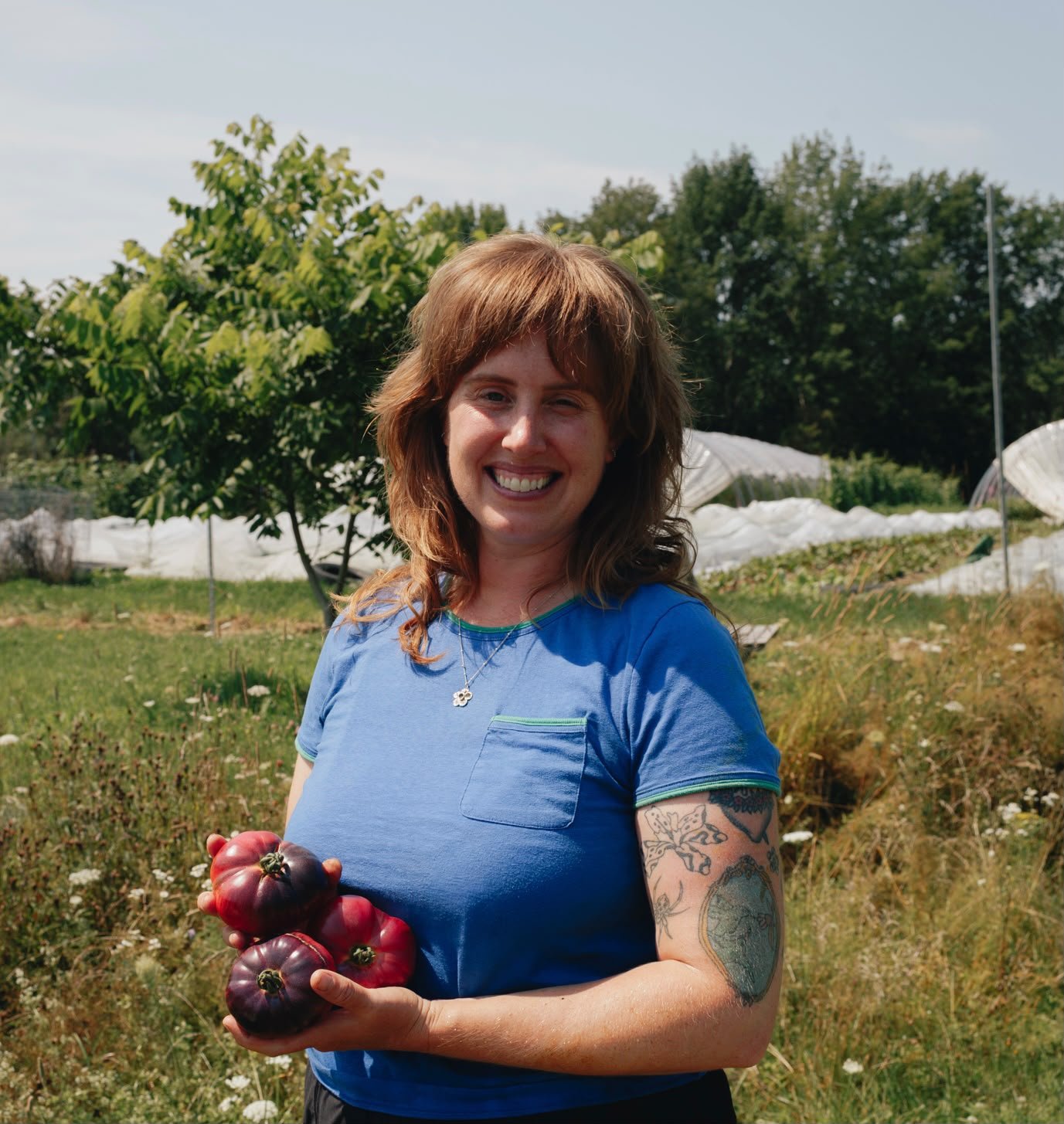
Jessie on her farm.
Could you tell us a bit about your work as a scholar-activist and small-scale farmer? What questions, challenges, or possibilities are most shaping your work right now?
The reason I got into farming in the first place still shapes the work I do today. I studied International Relations and wasn’t really sure what I wanted to do. After working on a few small farms and travelling, I decided to try working on an organic farm when I got home and I absolutely loved it. I happened to be working on a farm where the farmer was politically involved and passionate about food sovereignty, a term I hadn't come across before That really sparked my interest in learning more about food as a right, advocacy, and becoming involved in a farming community that aligned with my values.
Farming has become a way for me to make an impact locally, not just by advocating for food systems change but actively trying to shift what our local food systems look like. Farming is political; we're using land and resources and trying to feed people, all of which are tied up in political and economic realities. Small-scale farming, which has been pushed out under the corporate food regime, feels especially important now. We're trying to emphasize the importance of local and territorial food sovereignty at a time of multiple crises, declining numbers of farmers, increasingly precarious global food systems, and the erosion of rural communities.
My work spans many different scales, and it's difficult to compartmentalize them because the challenges and opportunities are interconnected. Whether I'm working on my farm or supporting La Via Campesina through its International Coordination Committee, I see many of the same issues facing young and new farmers around the world. On the farm, we're asking how we can pay ourselves a living wage, maintain our commitment to agroecology when production costs are so high, and continue serving our community when people are struggling with their own living expenses. I think one of the most important things we need is strong farming communities. In Nova Scotia, we haven't had an intentional network of agroecological farmers who recognize food sovereignty as the guiding principle behind their work. A group of us has been trying to build that network over the last couple of years through the National Farmers Union (NFU).
The NFU is a national organization rooted in food sovereignty, sustainable livelihoods for farmers, and just agricultural policies. It's also a founding member of La Via Campesina. Nova Scotia has historically had very little NFU presence, and we're currently advocating for the organization to receive farm business organization status in the province. Even though that's an uphill battle, the process is bringing together like-minded farmers who haven't necessarily had a network before. We're also emphasizing mutual aid as a way to build solidarity among farmers and farm workers.
Nationally, I've spent much of the last decade trying to bridge the knowledge gap around the importance of global solidarity within the food sovereignty movement. The NFU has been explicit in its support of the people of Cuba and Palestine, including through material support and advocacy. As one of the co-chairs of the NFU's international committee, I've been working with other members to embed an internationalist perspective into our agricultural policies and advocacy.
Internationally, I sit on the coordination committee of La Via Campesina. Each of its ten regions elects three representatives to the committee, which brings together roughly 30 people from around the world. We meet twice a year to discuss the movement's priorities, upcoming events, financial autonomy, and political education. I've learned an enormous amount from the leaders involved.
Sometimes it feels overwhelming to work across so many scales, but ultimately, the through line is food sovereignty. Whether I'm working in the field or at the international level, the struggle for food sovereignty exists at every scale. Everything is interconnected, and we have a responsibility to understand what's happening around the world and embed global solidarity into the work we do.
In law we often think about the short term, how we respond to a client's needs or address a pressing issue. What, if anything, do you think would be different if we start thinking in terms of generations when developing the laws that govern our food systems?
If there were a conscious shift and the political will to think in terms of generations when governing food systems, I think we could transform them. Throughout history, people have gathered, hunted, and produced food to survive but agriculture as we know it today is a settler-colonial project. It's attempted to erase Indigenous histories around food, place, and the ways people move to obtain what they need, along with Indigenous sovereignty more broadly. The industrialization of food intentionally overlooked these histories and futures in favour of the present. That's ultimately at the root of capitalism: the drive for profit now, at all costs. Capitalism and generational thinking don't mesh well because corporations have very little incentive to prioritize people and the planet.
If we want future generations to have enough to eat and live in healthy environments capable of producing food, we need to address these structural issues. Capitalism will never put people and the planet first, and Indigenous sovereignty needs to be reinstated and upheld.
Thinking generationally would mean recognizing the root causes of how we've arrived where we are today: food costing more than many people can comfortably afford, and ecological systems approaching collapse. It would mean recognizing the importance of Indigenous sovereignty, not burying Indigenous histories and futures, but upholding treaties and acknowledging ways of relating to the land that capitalism could never offer and recognizing a history that the settler-colonial agricultural project has actively tried to erase.
It would also mean treating the climate crisis like the real threat it is. If we genuinely cared about future generations, we would be working urgently to protect our environments, land, water, and air, while holding accountable the corporations that have brought us to this point.
We also need to acknowledge that neoliberalism hasn't served us well. We need localized food sovereignty, strong rural communities, and vibrant, rights-based food systems where farmers and consumers, rather than corporations, are building the systems they need.
Ultimately, a generational lens would force us to confront the structural causes of the corporate food regime. Consumers, farmers, and Indigenous peoples aren't getting what they need because we're all under the heel of capitalist interests. Capitalism doesn't care about past or future generations; it cares about profit.
Through your involvement with the National Farmers Union of Canada and La Via Campesina, you’ve been a part of organizing at both national and international levels. Has this work changed how you understand the challenges facing farmers in Canada, or what it takes to build meaningful international solidarity?
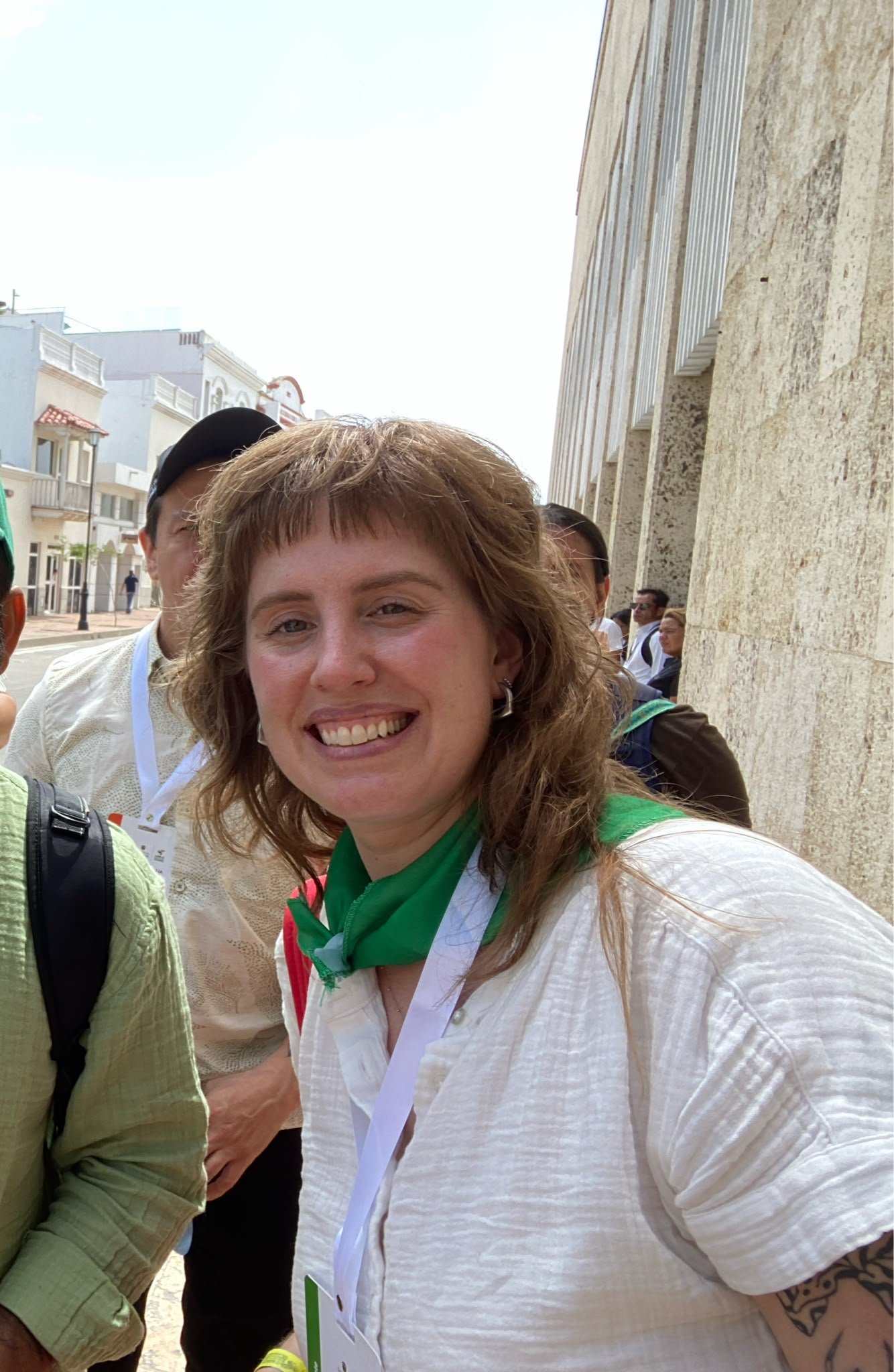
Jessie representing La Via Campesina at the ICARRD+20.
This work has definitely changed how I understand the challenges facing farmers. We need to continue building bridges as people who work with the land and connecting with people around the world who are also trying to live and work with the land. We're all inextricably linked. Since becoming more involved in the global food sovereignty movement, I've often heard farmers here in Canada question why international solidarity matters. Why shouldn't we spend our time advocating for local needs? We already have enough issues here. Why should we care about farmers elsewhere?
But we don't live in a bubble. In an era of free trade and globalized economies, we're connected whether people want to acknowledge it or not.
One example comes from my own farm. Over the last few months, I've been helping develop a guide for farmers through the NFU about boycott, divestment, and sanctions (BDS). Last year, the NFU passed a policy to embed BDS into our organizational structure, and we've been working on a guide to help farmers make more informed purchasing decisions, including how to avoid buying from Israel. I started looking more closely at where our seeds originated. As were a certified organic farm, we have to purchase organic seeds to meet our certification standards. While tracing some of the varieties we buy, I discovered that a basil variety called Prospera was bred by one of the world's largest organic seed producers, an Israeli company.
Most farmers wouldn't know this without tracing each individual seed variety. Canadian and US seed companies can import seeds without clearly identifying where those seeds originated.
Israeli agribusiness is a critical component of the Zionist project, including the illegal settlement and occupation of Palestinian land. The development of agriculture in the desert has been one way of taking over Palestinian land. So, by purchasing that seed, I was having an impact on Palestinian people, even without realizing it.
Canada also imports significant quantities of seeds, irrigation equipment, and other agricultural supplies from Israel. This is just one example, but it demonstrates how even a seemingly small purchasing decision can have a much larger impact on people elsewhere.
It's now almost impossible to be a farmer without having an impact on other parts of the world. Saying that we have enough issues at home isn't realistic because we're all interconnected. As farmers here (in Canada), I think we have a responsibility to stand in solidarity with farmers, farm workers, and landless people around the world. That solidarity can't just be abstract or symbolic; it needs to be material.
Meaningful international solidarity means building relationships with farmers and farm workers whose livelihoods are being affected by neoliberalism, war, and ongoing oppression. As a settler farmer in Canada, I recognize my privilege and understand that it comes with a responsibility to uplift the struggles of people of the land around the world. Whether we're self-employed farmers or working in another field, our choices and actions affect others. We have a responsibility to understand the impact of those connections.
Your PhD research examines youth’s contributions to and participation in transnational agrarian movements. What have you learned about the roles young people play in advancing food sovereignty, and what advice would you offer to youth who want to get involved in this work? What do young people bring to agrarian movements that might otherwise be missing?
One thing that continually surprises me is the scale of the generational renewal crisis in agriculture. Nowhere in the world are young people the majority of farmers. Young people have been leaving rural areas en masse, and Canada is no different. Since agriculture was incorporated into free trade agreements in the early 1990s, small family farms have suffered immensely. Parents are often encouraging their children to move to cities and find more secure work, while relying on selling their farmland to the highest bidder to secure a dignified retirement. And who can blame them? The system hasn't been set up to support farmers after they retire.
This has contributed to the gutting of rural communities, without any comprehensive strategy for supporting new entrants into farming. We simply aren't prepared to transform our food systems through food sovereignty if young and new farmers can't access land, obtain the tools they need to produce and distribute food, and earn relatively dignified wages.
At the same time, through my participation and research with La Via Campesina, I've encountered an incredibly strong network of creative young farmers and leaders finding ways to engage young people in their regions and bring them back to the land. I think this generation has grown up seeing the impacts of neoliberalism firsthand: the destruction of the land around them, the effects of agribusiness on rural communities, and the erosion of food cultures. I'm seeing young people bring a sense of urgency to spreading agroecology, organizing popular education and political education trainings, hosting seed-saving initiatives, and developing creative solutions to land access. It's difficult to compete with the resources of agribusiness, but the young people I've met through La Via Campesina are gradually chipping away and claiming food sovereignty in their regions and territories. In this era, you can either be complacent or resist. But La Via Campesina goes beyond resistance. It's about generating the alternatives that communities need and understanding what's possible when food sovereignty becomes the lens through which we think about feeding our communities.
For young people who want to get involved, I think the most important thing is finding community. Community isn't optional when it comes to farming. Strong networks of young farmers are fundamental to building food sovereignty. We need each other to rely on, work together, learn from our mistakes, organize, and advocate for one another. It's messy and difficult to build community, but we need each other. We need to have fun, and we need to have hope. Farming was never meant to be a solo pursuit. This is also why I'm so passionate about building up the NFU in Nova Scotia. If agroecological farming is going to make inroads against agribusiness, we need to keep building our networks, communities, and mutual aid processes. We need to reclaim the rural landscape as a place of possibility and community because so much of that has been gutted. We're under-resourced and often working on a shoestring budget to create platforms for farmers who share similar ideas about food sovereignty. But it's happening. Honestly, I don't know if I would still be farming without my La Via Campesina and National Farmers Union communities. They're that important to me. I think that's how we'll see more young people getting involved, too: by helping them find not only purpose in farming itself, but also purpose in the communities we're building toward a better food future