2019 CAFLP Annual Conference Panel Recap: “Changing the Quality of Foodland Protection: Exploring the Roles of Indigenous, Federal and Local Governments”
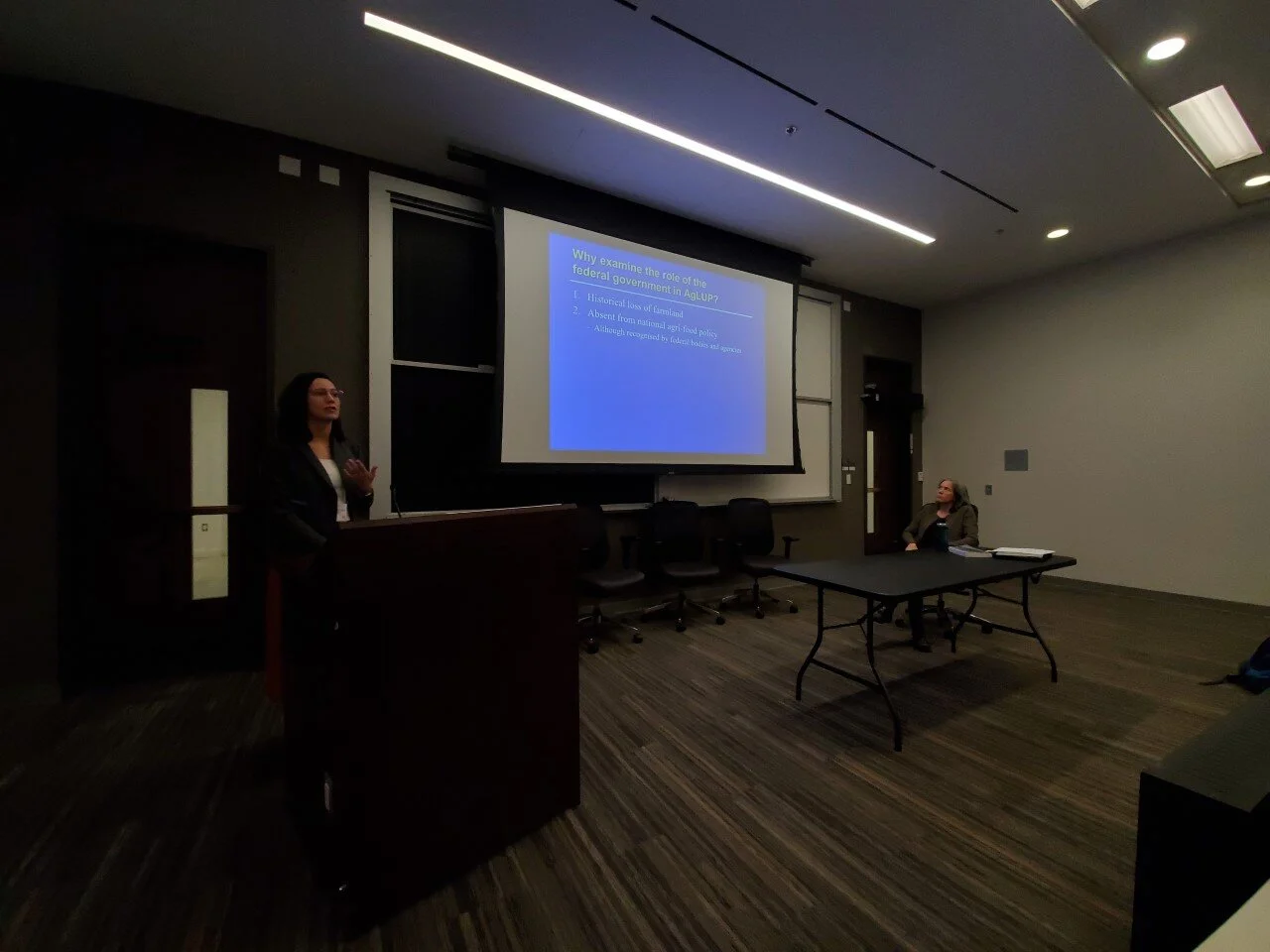
We need to broaden the conversation around foodland protection from narrowly focusing on protecting and preserving agricultural lands to addressing the needs of foodscapes more broadly. Yet, the legal complications that exist around the question of agricultural land protection alone suggest a need for greater scholarship on the topic. Deborah Curran and Rebeca Macias Gimenez from the University of Victoria Faculty of Law presented on their current collaborative project on the topic with David Connell* from the University of Northern British Columbia.
Foodscapes capture the extent of the landscape that contributes to our food supply and fosters our relationship to the land through food sources. It includes land, water, marine environment, and nontraditional farming systems like urban roof gardens and greenhouses that recapture abandoned industrial space. Agricultural land alone covers 7% of Canada, but the area covered by foodscapes more broadly covers a much larger, though uncalculated, area. Provincial governments and municipalities are the main drivers of land-use and development decision-making. While British Columbia, Quebec and (up until recently) Ontario have made efforts to protect agricultural lands, there is less engagement with the issue in other provinces. Even the efforts made by forward-thinking provinces is likely not enough to ensure that Canada as a whole has access to sufficient foodland in the next several decades.
Can the federal government step in to drive a coordinated national approach to protecting foodlands in Canada? While the federal government has abdicated this responsibility to the provinces in recent years, it does have the authority to regulate foodlands. Though farmland has been traditionally considered to be the jurisdiction of the provinces in practice, there is space in § 95 of the Constitution, the POGG Clause (Peace, Order, and Good Government), and through the Agriculture and Rural Development Act, 1985. Section 95 of the Constitution provides that “the Parliament of Canada may from Time to Time make Laws in relation to Agriculture in all or any of the Provinces.” A cooperative federalism model would allow for greater coordination in efforts to preserve agricultural land across Canada. Once the precedent is set, hopefully the scope of protections could be applied to foodscapes more broadly, not only agricultural land as it is traditionally conceptualized under the colonial model.
*While David attended the panel, he was unable to present or discuss his piece of the project due to a strike. Deborah and Rebeca were kind enough to present his slides for him.