2019 CAFLP Annual Conference Panel Recap: “Rethinking Governance: Rights, Realities and Alternatives”
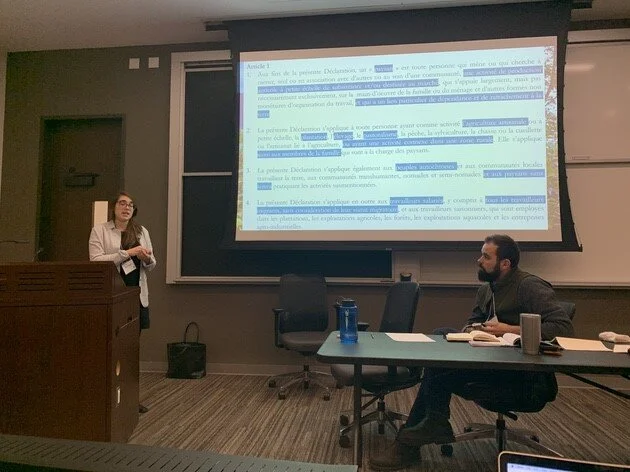
The United Nations Declaration on the Rights of Peasants and Other People Working in Rural Areas is the first international legal declaration recognizing peasant’s rights. It defines peasantry and acknowledges the role of peasants around the world as they are feeding a huge part of the world’s population and yet remain an incredibly vulnerable group. Indeed, 80% of the 770 million people living in extreme poverty are in rural areas and 64% of them work in agriculture.
The declaration is very important as it is a sort of point of arrival of a long fight in the area of international law. Interconnectedness of people and livelihood is central to the Declaration. The need to understand that peasants’ role is not just to keep people and the world well-fed, but they also have their place as part of that system, which is also fundamental in the declaration.
Too-soft law?
Recognizing the essential role that the Declaration played in the recognition of the role of peasants, Alix Grenier, a McGill Law graduate, is sceptical of the impact it can have on peasants’ lives. Her motivation to study law was to help others overcoming language barriers. This led her to work with farmers in Tunisia during a human rights internship. Alix did not see the impact of the Declaration on their everyday life as of yet. Because it is a non-binding international law instrument, she doubts that the Declaration can provide change without making governments accountable for it.
Alix believes the preamble of the Declaration has quite ambitious goals. While it “reaffirms” peasants’ rights, it also identifies various issues connected to food, including but not limited to, small-scale farming, poverty and hunger in rural populations, access to land, water and seeds, means of production, displacement, overrepresentation of women in agri-work, climate change, etc.
We should still care about the declaration, says Alix, as it dismantled the top-down approach, democratised the negotiation process by bringing the people who are usually invisible back in the conversation, and legitimized farming identity by a making it a safe space for conversation. She also argues that it is granting legitimacy to these voices. But the big question that remains is what comes next?
“Seeds are at the basis of life.”
Stuart Oke, a farmer and member of the Organisation of farmers of Canada, was part of the groups pushing for the Declaration. He views the Declaration as a tool for people who are pushing for government recognition of their rights. The expression “peasant” tends to have a pejorative connotation in Canada, as it promotes an alternative view to an extractivist/high-scale view of farming today.
What exactly is the difference between peasants and farmers?
Stuart and his colleagues identify themselves as “peasant farmers”, to communicate a philosophy, a way of life and how they relate to the food system. Agroecology is a way of life for peasant farmers like Stuart. It is about feeding themselves and their community. The relationship between people who eat and those who produce the food (who can be the same people) is at the heart of agroecology. It deplores the system of commodification which isolated us from the land. Food is interconnected to culture. By distancing us from where it is produced, we come to see food as fuel. Commodification of seeds leads to imperilment of life, as seeds are at the basis of life. Transparency is central to agroecology. The shorter the production chain, the higher the accountability because of the greater proximity with food producers.
Finally, while both panelists recognize the central role of law in moving forward, Alix doesn’t see international law as the right tool to do so and Stuart stresses the importance of passionate lawyers’ support in fighting this battle. There is a real potential in the climate crisis to bring the different actors together.