CAFLP Conference Recap: “Elbows Up” : Trade, Tariffs and Cross-Border Food Fights
DATE: October 24, 2025
SPEAKERS: Marjolaine Mondon & Jocelyn Roy, Mathew Smith, Mark FeDuke
MODERATOR: Elaine Feldman
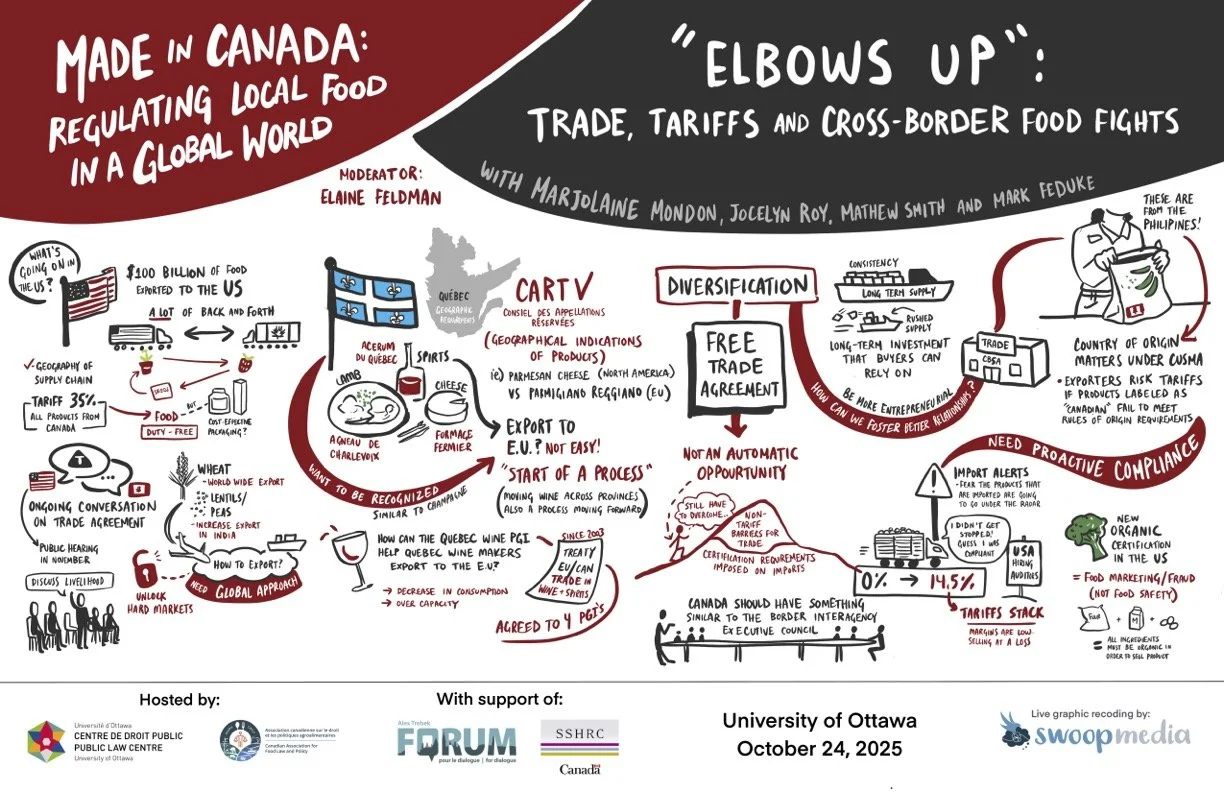
Image by Laura Hanek, Swoop Media
During a time of great uncertainty in international trade relations, the Canadian Association of Food Law and Policy’s 2025 Annual Conference featured an insightful conversation between professionals and scholars working in the field of international food trade. The timeliness of the panel was pointed out by moderator Elaine Feldman (Senior Fellow, Graduate School of Public and International Affairs, University of Ottawa) who noted that just that morning, U.S. President Donald Trump has said that all trade deals with Canada were off, but Prime Minister Carney had indicated he was willing to continue negotiating.
The panel featured Mathew Smith (Chief Agriculture Negotiator and Director General, Agriculture and Agri-Food Canada), Marjolaine Mondon & Jocelyn Roy (Conseil des appellation réservées et des termes valorisants du Québec), and Mark FeDuke (Director of Trade Compliance and Policy, Ardo VLM Foods Inc – also a Board Member of CAFLP).
Diversification & Globalization of Canadian Food Trade
Mathew Smith began the conversation by advocating for a diversified and global approach to food trade in Canada. The vast majority of Canada’s annual $100 billion in food exports have historically gone to the US, which is both the world’s biggest economy and our closest trading partner. However, trade is more than just about money; it is linked with culture, the way people live, and security issues that come with it. The combination of these factors – alongside costs – have meant that the current political situation is destructive for many businesses.
For example, supply chains have been built up based on the ease of cross-border transportation. This ease is such that transportation has been a question of geographical proximity, rather than the presence of a border crossing. US businesses with both internal and international divisions have even included Canadian divisions in their internal ones, where those Canadian divisions are located close to a border. Geographical proximity has shortened supply chains and provided business advantages; now, however, the impact of President Trump’s tariffs has changed how businesses must be run.
Although food and agriculture are still exempt from blanket tariffs, the future is uncertain. President Trump has advocated for changes to the USMCA trade agreement through the built-in review clause. The US conducted a public hearing in mid-November, which was projected to largely consider feedback from businesses; similarly, the Canadian government was taking in comments from the public until November 4.
Ideally, Canada should look at diversifying its trade markets in order to prepare for potential fallout from these impacts. Other markets are also changing; for example, India has historically been a large buyer of lentils and peas grown in Saskatchewan, but is now increasing efforts to grow those products domestically. Therefore, different strategies are needed for different types of products. Additionally, efforts to expand trade markets typically look to countries with shared values, but a shared valued system does not necessarily mean that there is space to receive Canadian exports; the EU, for example, is also aiming to increase domestic production.
Protected Designations in Québec-EU Trade

Photo by Glenford Jameson
Marjolaine Mondon and Jocelyn Roy followed with an engaging overview of protected designations in Québec. Adopted in 2006, Québec’s law on protected designations (whether time-reserved, geographical, or otherwise) ensures that designated products are credible outside of the province. The power to recognize protected designations of food and drink products rests with the Minister of Agriculture.
Protected designation is an IP right and a collective good, protected by the Province of Québec for the benefit of society as a whole. Standards are collectively determined by producers, analyzed and recognized by the Minister, and then monitored by independent third-party certifiers. This assures the traceability and integrity of products as they cross borders.
Québec boasts a unique and rigorous designation system. For example, organics, which have been protected and recognized in Canada since 2012, received protection in Québec in 2000. The 2012 pan-Canadian regulation provides the standards for organic products once they leave Québec borders. Around 3,500 Québec companies hold organic certification, and around 100 others are certified by other designations. The newest of these is “Acerum du Québec”, a brandy made from fermented maple sap, which received protected designation in April 2025.
Québec’s wines can also be protected, under the designation “Vins du Québec”. Despite being relatively new, and having been considered lower quality until recently, Québec’s wine production industry is setting its sights on exporting. The designation, in this case a protected geographical indication, is aimed at helping improve and regulate the quality of Québec wines. “Vins du Québec” designated wines must both be grown within certain regions of Québec, and follow agri-climactic specifications.
However, exporting – especially to the EU – comes with its own challenges. The EU wine market is world renown, and also over-productive; at the same time, global alcohol consumption is decreasing. Where there has been interest in importing Québec wines, differences in administrative processes have caused significant roadblocks. Under European certification, wines must be chemically analyzed, and production processes must comply with good practices. Global Affairs Canada has now assisted in getting three laboratories in Québec certified to European standards. Canadian wines from Ontario and BC were previously accredited in the EU based on trade agreements established in 2003.
Although that process is now starting with Québec wines, the ultimate goal is to have “Vins du Québec” accredited in the EU for more efficient trade. This will become particularly relevant as the effects of climate change affect the ability to grow grapes in regions on which European wines rely, for example the Mediterranean basin. Jocelyn Roy ended the presentation on an optimistic note, expressing a hope that “in the near future, cool climate wines will become really cool.”
Complacency & Non-Compliance as Barriers to Trade Diversification
Photo by Hermes Rivera on Unsplash
Mark FeDuke began by addressing some of the challenges associated with trade diversification efforts. He pointed out that in the lead-up to the EU-Canada free trade agreement, many thought the pork market would open up as a result, but that did not ultimately materialize. Similarly, as noted by the previous presenters, European non-tariff and technical certification issues also act as barriers; therefore, the presence of a free trade agreement does not mean that trade will flourish. Diversification also takes time and resources. Entering new markets means either competing with established suppliers, or introducing new differentiated products to expand rather than congest markets.
Another barrier to maintaining trade in the face of changing regulation is the complacency which has been built up throughout Canada’s history of easy trade with the US, especially since food is not as closely monitored as other forms of trade. The lack of oversight and inspection of products shipped into the US from Canada allowed for Canadian companies to ship duty free into the US, even if the product was imported. Ultimately this led to a dispute with US customs, resulting in rulings from the Court of International Trade and the US Federal Appeals Court confirming that products packaged in Canada are not considered to be Canadian for the purpose of duty-free trade.
Efforts are underway by US customs to curb this complacency, including hiring additional auditors. Consequently, it is becoming more likely that non-compliant products will be stopped at the border; as the US moves to a tariff-based trade system, collecting on those tariffs is increasing in priority.
Competition in diversification efforts can also act as a barrier, particularly in the light of shifting trade relationships. USMCA compliant foods can still enter the US duty-free, but that is not the case for other countries, even those with free trade agreements with the US. Those countries will consequently be seeking to expand to other markets, while the US also increases efforts to diversify exports. A trade deal currently in development between the US and the EU would impose a flat 15% tariff on products coming into the US, with American goods going to the EU having a 0% tariff. While this agreement might benefit Canadians exporting to the US, it simultaneously puts Canadian producers in competition with the US – as well as other countries looking to expand to non-American markets – for exports to the EU.
As we move forward to expand trade opportunities, businesses need to have the courage to step up and increase diversification, but support from regulators and policymakers is also needed. For example, before the current US administration, the Customs and Border Patrol Office of Trade Relation’s mandate was to produce, facilitate and promote legitimate trade, including aiming for reform where possible. In comparison, the Canadian equivalent (CBSA Office of Trade) focuses on enforcement only. Therefore, as Canada aims to diversify trade, it needs to be entrepreneurial, as well as understanding what requirements and demands are in other markets.
Audience questions: Organic certification, CUSMA non-compliance
In response to a question about the cross-fertilization between issues of trade and certification schemes on the federal level, Mark FeDuke highlighted recent difficulties that Canadian producers are having in complying with US organic food requirements. While these requirements have been widely framed as “new”, they date back to 2020 and were revised in 2022. Historically, the US has made accommodations for Canadian organic producers, but compliance is now being more heavily monitored. Notably, organic certification is concerned with food marketing rather than food safety; the crackdown on compliance is related to the prevention of fraud and protection of organic premiums.
Mathew Smith added that while equivalencies in certifications are rare, they do exist between the US and Canada. Historically, products that have been the subject of equivalency agreements have been omitted from trade agreements, but this is becoming more complicated, and even more so where there are questions of IP. Protected geographical indications are typically limited to wines and spirits, but the Canada-EU trade agreement allows for the protection of food names as well, limiting Canadian businesses from marketing foods using names protected in the EU.
Another audience member asked about high levels of CUSMA non-compliance within the organics sector, specifically related to supply chain issues. If a significant ingredient (for example, coffee) is not available in Canada and must be imported, the product cannot meet the origin rules under CUSMA. Mathew Smith noted that coffee was an interesting example, since there are few domestic coffee producers in the US outside of Puerto Rico and Hawaii. Previously, coffee has not been addressed by trade agreements and has never been tariffed; now, coffee has been caught in the net of broad strokes tariffs. The average cost of coffee is up in the US, and while the coffee industry is asking for exceptions to be made, currently the US government is not making any changes. There is growing effort in the US to bring attention to other industries affected by broad strokes tariffs.
Mark FeDuke noted that CUSMA non-compliance could create larger risks for other agreements with the US. For example, the Canada-US food safety systems recognition agreement could be repealed if a foodborne illness outbreak in the US was associated with an import from Canada that was not CUSMA compliant – particularly if the product or any of its components were not Canadian in origin and not properly inspected in Canada. Canadian companies should therefore subscribe to USFDA import violation alerts, so that they can know if something in their product has been flagged.