CAFLP Conference Recap: Agricultural Data: A Blind Spot in Canadian Public Policy?
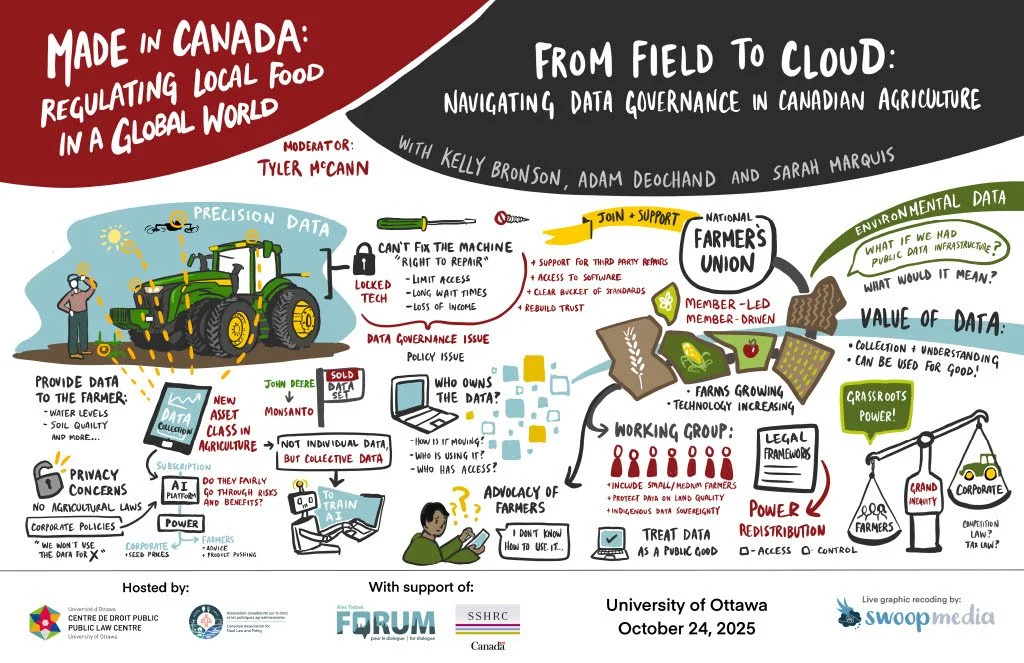
Image by Laura Hanek, Swoop Media
(Pour une version française, cliquez ici.)
Digital agriculture, also referred to as “precision agriculture” or “smart farming,” is now widely promoted as a technological response to the combined challenges of food security and sustainability. Sensors, drones, satellites, decision-support software, and artificial intelligence generate continuous data flows that enable crop monitoring, task automation, and the optimization of input use. By promising greater productive efficiency and cost reductions, these technologies are presented as a central lever of the agricultural sector’s transition.
Beyond individual gains for producers, the argument is framed in broader, systemic terms: the fine-tuned optimization of scarce resources and the reduction of polluting inputs would make it possible to reconcile economic performance with ecosystem protection. Digital agriculture is thus embedded in a rhetoric of comprehensive solutions, in which data become the new flagship resource of the transition. Like water or arable land, data are increasingly conceived as an economic resource on which many actors seek to capitalize.
Data, Markets, and Power Asymmetries
By combining inputs, equipment, and data platforms, major seed companies, agrochemical firms, and historically dominant machinery manufacturers have extended their control to digital infrastructures, noted Professor Kelly Bronson at the 9th Annual Conference of the Canadian Food Law and Policy Association.
While producers may benefit from marginal efficiency gains through improved agronomic precision, researchers, NGOs, and public agencies warn of the emergence of a “new asset class” concentrated in the hands of a few corporations[MOU1] [MOU2] [LA3] . As the digitalization of agriculture marks a turning point in the production of economic value in agrifood sector, the consolidation of dominant positions raises fundamental governance issues, insofar as control over data infrastructures also entails control over markets, knowledge, and narratives about the future of agri-food systems.
From a legal perspective, this transformation is occurring in a relative vacuum. There is no specific legal definition of agricultural data at the federal level. Certain provisions of the Personal Information Protection and Electronic Documents Act (PIPEDA) may apply where data allow the identification of a farm or its commercial practices. Bill C-27, which aimed to regulate artificial intelligence and strengthen data protection, suggested potential progress, but its postponement[MOU4] [LA5] has prolonged the absence of a coherent framework.
In this context, governance largely relies on private agreements. Farmers’ access to services is conditional subject to the acceptance of licensing agreements drafted by companies, which determine permitted uses, sharing rights, and mechanisms of value capture.
The systemic analysis of these private policies by Professor Kelly Bronson and her colleagues identifies three central mechanisms of appropriation. First, the creation of dependency relationships through locked-in systems that tie together seeds, machinery, software, and services. Second, the ability to engage in differential pricing through the large-scale aggregation of predictive data. Third, the development of products and commercial strategies based on fine-grained profiling of territories and farming practices.
Data thus serves not only to improve agronomic performance; it becomes an instrument of economic power. “Our results indicate the reproduction of asymmetrical power relations in the agri-food system favoring corporations and the continuation of long-standing dynamics of inequalities,” the authors conclude in their article published last year. The central question therefore becomes that of redistributing the benefits derived from this new resource.
From Innovation to Dependency: Regulatory Blind Spots

Photo by Glenford Jameison
These asymmetries materialize through technical and legal obstacles, foremost among them the lack of interoperability. Connected equipment and platforms rely on incompatible proprietary formats, hindering data exchange and the integration of tools from different suppliers. For Adam Deochand, analyst at Agriculture and Agri-Food Canada and speaker at the 9th annual CAFLP conference, this creates a vicious circle: “as digital agriculture has shifted away from farmers and towards platforms, producers enter into licensing agreements, sign these contracts and give up control of their data.”[MOU6] [LA7]
This dependency extends into the material sphere. Software locks restrict independent repair and maintenance. “When farmers cannot repair their machines or access diagnostic information, they lose far more than time and money. They lose their independence and their right to repair,” Deochand emphasized. [MOU8] The issue is therefore not merely technical, but one of broader economic equity and rural justice.
Recent Canadian reforms (Bills C-244 and C-294) have introduced copyright exemptions to allow diagnosis, maintenance, and repair. In this respect, they align with international developments, notably the Organisation for Economic Co-operation and Development (OECD) recommendation on data governance and, in Europe, growing requirements regarding access and portability.
Three dimensions of interoperability nevertheless warrant particular attention in the design of a future federal governance framework. The first concerns connectivity between equipment, sensors, and platforms, so that data can circulate independently of brands. “At present, this connectivity is constrained by proprietary barriers. Each system speaks its own language, creating technical silos with legal and economic consequences,” noted Deochand.
The second relates to the traceability and accountability of data flows, which are prerequisites for the effective enforcement of rights, privacy protection, and oversight of commercial practices. The third concerns normative infrastructure, which Deochand described as follows: “If we think of infrastructure as roads, bridges, or fiber-optic cables in a digital economy, data standards are infrastructure. They are invisible highways that allow innovation to circulate efficiently and fairly. Without them, each new technology becomes a private toll road.”
Across these three dimensions, and provided that law and policy define not only who owns data but also how they circulate in a secure, fair, and transparent manner, interoperability emerges as a promising guiding principle for a future governance framework. In the absence of baseline standards, Canada risks instead a fragmented system in which innovation remains siloed and farmers bear the direct consequences.
Farmers at the Heart of Digital Transformations
These debates resonate strongly from the perspective of rural communities. For Dr. Sarah Marquis of the National Farmers Union and third speaker on the panel, the precautionary principle should guide the introduction of new technologies: “Historically, the development of new technologies and machinery over the past century has been accompanied by a trend toward consolidation and concentration of land ownership,” with lasting effects on access to land, the diversity of production models, and the vitality of rural territories.
In response to these risks, the concept of technological sovereignty is emerging as a new framework. Inspired by food sovereignty, it seeks to guarantee “the right of farmers to determine how technologies are developed, accessed, and used, and to ensure that they serve the collective interest rather than corporate interests.” [MOU9] [LA10] It also relates to Indigenous data and knowledge sovereignty in a Canadian context where digitalization risks perpetuating colonial dynamics of extraction and appropriation.
To account for a plurality of perspectives, it is also essential to consider the situation of non-owner agricultural workers, particularly migrant workers, for whom the digital transition has ambivalent effects. Research by Olivia Doggett shows that digital tools are sometimes used as instruments of surveillance, generating stress and precarity. Dimensions that remain largely absent from public debate.
Agricultural Data and the Public Interest: What Role for Law?
In conclusion, while the value of agricultural data is currently framed primarily through a market-based lens, alternative approaches call for a legal requalification. Such data is essential not only for corporations and producers, but also for public research, territorial planning, the protection of natural and cultivated ecosystems, and, more broadly, for the realization of the right to food.
Viewing them as public goods or commons rather than as mere private assets opens the door to alternative governance models: data cooperatives, data trusts, and benefit-sharing obligations. Still marginal in Canada, these instruments could contribute to a redistribution of informational power and to innovation genuinely oriented toward the public interest.
As agriculture becomes fully embedded in the data economy, the central challenge for law is no longer solely to determine the formal holders of information, but to define the collective conditions under which data are produced, circulated, and shared. In other words, the task is to organize legally the access to, use of, and distribution of the value generated by agricultural data so that they effectively serve the public interest. The digital governance of agricultural data thus emerges as one of the structuring fields of agri-food law in the twenty-first century.